

Key Takeaways
- Cloud VoIP delivers five-nines availability through geo-redundant data centers.
- Self-hosted PBXs offer full data custody and ownership of encryption keys.
- Dynamic E911 in cloud VoIP automates address mapping and routing.
- Cloud UCaaS delivers faster innovation through managed updates and AI features.
- Self-hosted PBX ensures branch-level call continuity even during internet outages.
- Cloud VoIP platforms shift cost from CapEx hardware to flexible per-user/feature OpEx.
- Cloud VoIP telephony simplifies integrations with ready APIs and supported connectors.
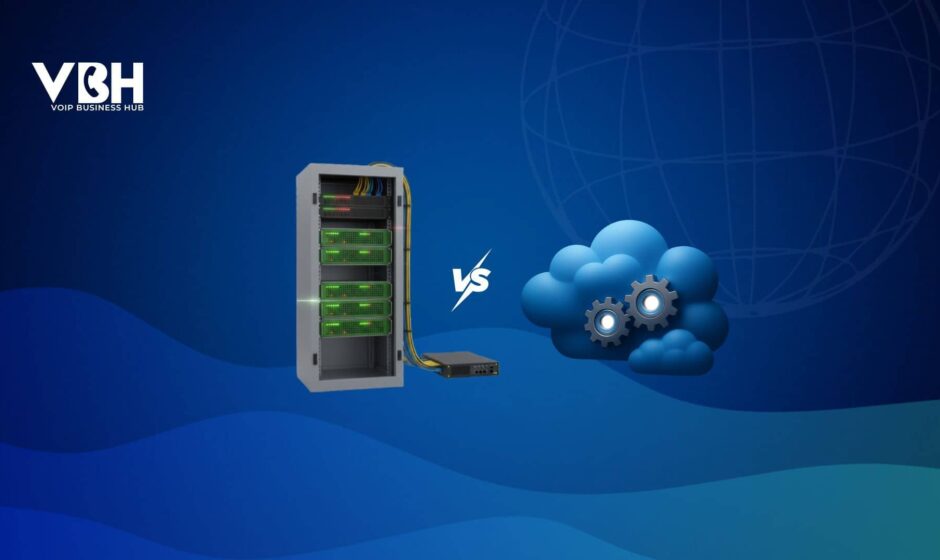
Telephony’s risk lies less in dialing and more in the stack that decides how calls fail. So the fork in the road is simple: do you engineer a PBX to fail well, or a cloud service you hold to an SLA?
Reports also indicate that about 30% of organizations already rely on cloud office platforms for enterprise telephony, a figure expected to surge to 90% by 2028.
So choosing between self-hosted VoIP and cloud VoIP requires understanding who controls the call, how you will meet compliance obligations, the 5-year TCO per seat, network readiness for latency/jitter, feature capabilities & integrations, and your exit strategy. Let’s understand these differences in detail with this blog on Self-Hosted vs Cloud VoIP.
What is Self-hosted VoIP (on-prem / private-cloud PBX)?
A self-hosted VoIP system is a phone platform your company owns and operates in its own data center or private cloud. You control the data, security, uptime, and upgrade schedule, and you can tailor call flows and integrations to fit how your business actually works.
What is Cloud VoIP (hosted PBX / UCaaS)?
Cloud VoIP is a phone system your company consumes as a service. The third-party provider runs the PBX in its cloud and maintains upgrades, security, carrier interconnect, and compliance, while your team manages users, numbers, policies, and locations through an admin portal. Pricing is typically per participant and supports remote/hybrid calling.
9 Self-Hosted vs Cloud VoIP Differences in Detail
1. Reliability & Survivability
Self-hosted PBX puts uptime in your hands. Clustered call controllers, paired SBCs, dual ISPs with SD-WAN, and DNS-SRV failover so endpoints re-register when a node or carrier drops. If the internet goes dark, local trunks keep branch phones talking and outbound calls flowing.
Cloud VoIP/UCaaS bakes resilience into the platform. Geo-redundant data centers, automatic failover, and five-nines availability as top preference. You don’t design the backbone; instead, you harden your edge: QoS on the LAN, solid circuits, and a clear playbook for breakdowns.
2. E911 accountability
When a user dials 911, the call must go out directly (no prefix), and the dispatchable location (street address plus floor/room/area) must reach the PSAP, and your organization must receive an on-site alert. That’s the core of 911 obligations for U.S. multi-line/VoIP systems.
Self-hosted PBX
You run the emergency-calling stack:
- maintain ERLs/ELINs (Emergency Response Locations / Emergency Location Identification Numbers)
- map extensions or subnets to routable callback numbers
- operate or integrate with a Location Information Server (LIS)
- populate endpoints via LLDP-MED (for desk phones) or network heuristics (VLAN/subnet/Wi-Fi BSSID)
You also manage trunk routing and periodic validation so hot-desks, warehouse handsets, and nomadic softphones resolve to a verified address every time.
Cloud VoIP/UCaaS
Dynamic E911 is built into the VoIP telephony platform. You map civic addresses to networks (subnets/BSSIDs), enable user prompts for remote workers, configure on-site notifications, and let the provider’s emergency service do the LIS and routing behind the scenes.
The admin work is still yours, i.e., per site and per user, but the discovery, policy, and routing features are packaged (e.g., Teams dynamic emergency calling, Zoom Nomadic E911).
3. Data Custody & Encryption Keys
Who keeps your call data and who holds the keys decides your discovery and audit posture.
Self-hosted PBX
You place CDRs and recordings in your own storage (object buckets) under your retention rules and hold the encryption keys in your KMS/HSM. On the wire, you choose the controls, like SIP over TLS for signaling, SRTP for media, and an SBC to enforce edge policy.
For WebRTC softphones, media is encrypted by default with DTLS-SRTP and uses ICE/STUN/TURN for traversal. That combination gives you tight data residency and key ownership, plus direct export to SIEM or archives.
Cloud VoIP Telephony
Here, the cloud softphone provider hosts CDRs/recordings and manages service-side encryption at rest. You set retention and pull exports via the admin/API. Major platforms now offer customer-managed keys so you can “bring your own key” (BYOK) for at-rest encryption.
4. Caller-ID Trust
Your answer rates and brand reputation now depend on how your outbound calls are attested. STIR/SHAKEN adds a signed PASSporT token in the SIP Identity header so the terminating carrier can verify the calling number wasn’t spoofed. Calls are tagged with A / B / C attestation:
- A (Full): telephony provider knows you and that you’re authorized to use that caller ID.
- B (Partial): knows you, but can’t vouch for the number.
- C (Gateway): just passing traffic from another source.
The FCC’s latest “call authentication trust anchor” rules make it easier to get more calls signed and allow third-party authentication, a path many enterprises/MSPs can use when their own networks can’t natively sign calls.
Why this affects hosting choice?
Self-hosted PBX: You will originate through one or more SIP trunks/SBCs. To earn A attestation, work with carriers who can authenticate your enterprise identities and numbers before they hand calls to the PSTN. Misaligned caller IDs, sub-accounts, or cross-brand CLIs tend to fall to B/C, which can depress response frequency.
Cloud UCaaS Platforms: The platform usually signs on your behalf, and your job is to keep caller ID hygiene clean (one number per use case, consistent CNAM) and avoid patterns that trigger analytics filters. Even when a provider signs, you still need a robocall mitigation posture for any traffic they can’t fully attest.
5. Network Tolerance & Voice Quality
Real-time voice is brutally honest about your network. Two numbers matter most for human-sounding calls: one-way latency ≲150 ms and low, stable jitter. Go past those and you get talk-over, robotic audio, and dropouts.
That 150 ms comes from telecom’s long-standing delay recommendations and is echoed in modern UC tooling; admins also watch packet loss and MOS to keep quality predictable.
What to engineer (regardless of hosting)?
- Codecs: Use Opus for softphones/WebRTC (adaptive, packet-loss-resilient), SIP desk phones fall back to G.711 where needed.
- Transport & encryption: Prioritize UDP with TLS-SRTP / DTLS-SRTP; WebRTC handles traversal via ICE/STUN/TURN when NATs and firewalls get in the way.
- QoS: Mark and honor DSCP EF (46) for voice so jitter buffers don’t starve under load; verify it’s preserved end-to-end.
- Observability: Use your platform’s quality dashboards to track latency, jitter, packet loss, MOS, and spot burst loss or bad subnets before users do.
How hosting changes the experience?
Self-hosted PBX: You can keep local media paths for on-site calls and ride redundant SIP trunks out of each site, which reduces dependency on the WAN when two local endpoints talk. Your design still lives or dies on LAN/WAN and dual-link/SD-WAN policy.
Cloud VoIP/UCaaS: SLA ≠ your last-mile. You must groom campus Wi-Fi/LAN, internet egress, and VPN policies (avoid TCP-tunneled paths for media) to stay within those latency/jitter envelopes. Vendor tooling will surface thresholds so you can remediate before MOS slips.
6. Feature & Setting Control
Cloud UCaaS providers offer add-ons. New analytics, AI summaries, WebRTC softphone updates, and security hardening arrive without your maintenance windows. That’s velocity, but changes land on vendor timelines. You manage impact like release notes, feature flags, admin policy like provisioned settings or user removal/addition, and customization.
However, self-hosted PBX favors deliberate change. You stage upgrades, patch SIP stacks, rotate TLS certificates, approve phone firmware, and test IVR and queue logic before go-live.
7. Integration Posture & Extensibility
Self-hosted PBX includes dial plans, SBC policy scripts, CTI via AMI/ARI, custom IVRs, and event webhooks into your CRM, data warehouse, or CPaaS. You can run BYO SIP trunking, on-prem ASR/TTS, and queue logic that mirrors your workflows exactly.
Cloud VoIP phone systems optimize for time-to-integrate. Marketplaces for Salesforce, HubSpot, Zendesk, and Teams/Google; REST APIs; webhooks; SAML/OIDC SSO; and SCIM provisioning. You trade some low-level control for supported connectors and faster iteration.
Check API rate limits, event payloads, recording/analytics exports, and whether softphone SDKs or embeddable WebRTC widgets meet your app requirements.
8. Cost structure & 5-year math
The budget fragmentation is very different self-managed telephony platforms: PBX licenses, SBCs, servers, storage, HA gear, plus SIP trunks and power/cooling. Add staff time for patches, DR tests, and phone provisioning. Cloud UCaaS shifts to OpEx based on per-user seats, bundled calling, E911 fees, storage, support tiers, and optional AI/analytics.
Seat growth, recording retention, compliance add-ons, and international minutes can swing totals. Model two scenarios: steady participants and aggressive hiring, and include carrier minutes, DID inventory, survivability hardware, admin effort, and depreciation.
9. Switching Between Providers
Numbers should port between VoIP providers cleanly with CSR, LSR, and LOA, but timelines vary by losing carrier. Ensure you can export users, auto-attendants, queues, prompts, and call flows.
Get CDR and recording, clarify retention after termination, and any egress fees. With UCaaS, confirm data location, BYOK key destruction, shutdown behavior, and phone unlocks or provisioning credentials.
With self-hosted, document extension plans, E911 databases, dial plan scripts, and trunk routing. Preserve caller-ID reputation during migrations. Keep DNS, domains, certificates, and SSO/SCIM mappings separate so ownership remains clear.
How to Pick Self-Hosted vs Cloud VoIP
Both paths give you the same dial tone, but the real difference is where responsibility lives. If you need strict data custody, customer-managed keys, deep call-flow control, and branch survivability without the internet, a self-hosted PBX aligns with that control as long as you are prepared to fund and operate high availability, patching, and audits.
If you value speed, elastic scale, and a steady feature availability backed by a platform SLA, cloud VoIP infrastructure is the practical default, with far less on-prem hardware to own.