


If most of your revenue depends on phone calls, your VoIP setup is part of your business model, not just your tech stack. It decides how quickly customers reach you, how reliably agents can respond, and how much each call really costs.
Instead of comparing vendors, this guide focuses on the essential VoIP solutions themselves: VoIP numbers, PBX systems (on-prem and cloud), UCaaS, softphones, SIP trunks, and more.
Core VoIP Technologies for Enterprise Communications
Understanding the core VoIP solution types is essential for building a robust, scalable communication infrastructure.
1.VoIP Numbers: Foundation of Business Identity
VoIP numbers, also known as virtual phone numbers or Direct Inward Dialing (DID) numbers, are real telephone numbers that work over the IP network rather than a physical copper line. They can be provisioned in bulk across many countries. They are assigned to a user rather than a fixed location so that the same number can be used on any device with a VoIP app or client.
Types of VoIP Numbers:
- Local Numbers (provides geographical presence in specific area codes)
- Toll-Free Numbers (numbers, recognizable by prefixes like 1-800)
- National Numbers (offers freedom in multi-regional markets)
- Mobile DIDs (support both voice and SMS)
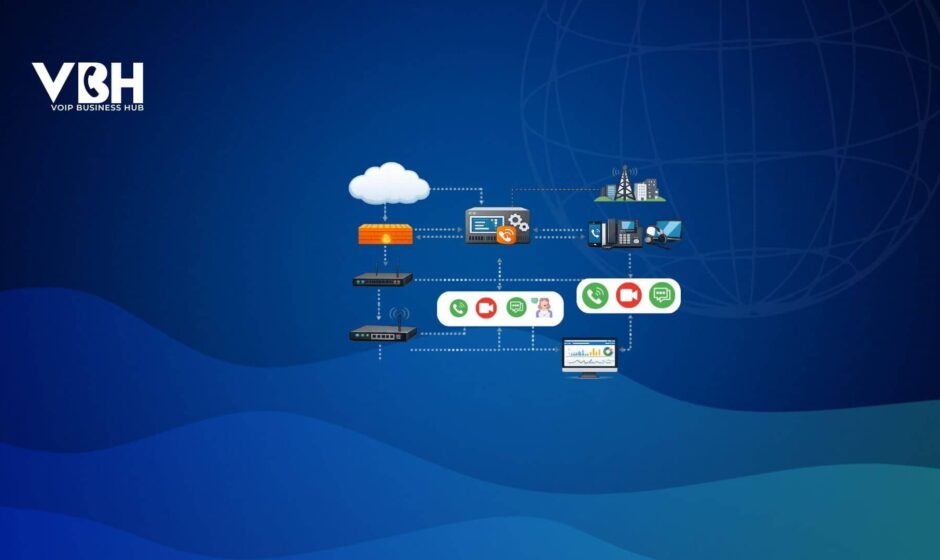
VoIP call flow: Customer dials → number terminates on your VoIP platform → routed through SIP trunks / SBC → into your PBX or CCaaS → rings agents’ softphones or desk phones.
Example: Using VoIP numbers, a financial services firm can add 100 customer service contacts in minutes, while a healthcare network can establish a presence in new markets overnight.
2. Softphones: Mobile-based Enterprise Telephony
Softphones are software-based phone applications that turn computers, tablets, and smartphones into full-featured business phones. They register with the PBX/UCaaS over IP and receive calls via VoIP numbers routed through SIP trunks and SBCs.
- Unified communications (UC) integration: Voice, video, messaging, and presence within a single application.
- CRM connectivity: Automatic call logging, caller context, and workflow triggers.
- Remote readiness: Essential for hybrid teams, field staff, and distributed agents.
- Cross-device continuity: Seamless use across desktop, mobile, tablet, and browser-based WebRTC softphones.
- Quick provisioning: Call-heavy organizations can add agents quickly by assigning a number/extension and logging in to the softphone.
Example: A managed service provider can equip 50 technicians with business phones solely through software, reducing capital expenditure by 60%.
3. PBX Systems: On-Prem, Hosted, and Cloud
Private Branch Exchange (PBX) systems serve as the central nervous system of business telephony, routing calls over IP instead of older TDM circuits. It provides call routing, extensions, IVR, queues, voicemail, call recording, monitoring, and other advanced communication features.
Cloud PBX:
Cloud PBX systems are hosted remotely by service providers. No physical hardware.
- Lower initial investment with subscription-based pricing.
- Minimal IT maintenance as providers handle updates and security.
On-prem IP PBX:
On-premises PBX systems run on business-owned hardware and servers, providing complete control over the communication infrastructure.
- High-quality internal calls operate over LANs, without internet dependency.
- Full data control and customization options appeal to regulated industries.
Hybrid PBX:
Hybrid deployments combine on-premises and cloud elements, offering flexibility for organizations transitioning to the cloud or managing multiple locations.
4. UCaaS: Unified Communications as a Service
UCaaS represents the convergence of multiple communication channels, bundling voice, video meetings, team chat, messaging, file sharing & collaboration into a single cloud-based platform.
- Rapid scalability without infrastructure changes
- Multi-device applications and centralized administration
- Reduced tool sprawl and improved user experience
- Lower upfront costs compared to traditional PBX systems
- AI-driven insights and productivity features
Highly significant for call-heavy businesses with hybrid or multi-location teams. However, it depends on internet quality and offers limited deep customization in multi-tenant setups.
5. SIP Trunking: The Virtual Phone Line
Session Initiation Protocol (SIP) trunking replaces traditional phones with virtual connections over the internet, connecting business PBX systems to the Public Switched Telephone Network (PSTN). It acts like a virtual phone line (or many lines) for voice, video, and other media.
- Replaces legacy phone trunks with IP-based capacity
- Each trunk supports multiple concurrent calls
- SIP manages call setup, routing, and termination
- Enables centralized connectivity while distributing numbers and call capacity across locations
Where it sits: PBX ↔ SIP trunk ↔ carrier/ITSP ↔ PSTN & mobile networks. It’s the “pipe” that carries your VoIP calls in and out of the public phone network.
6. VoIP Gateways: Bridging Legacy and Modern Systems
VoIP gateways are hardware devices or software applications that bridge traditional telephone networks (PSTN) and modern IP-based VoIP networks.
Gateway Types:
- Analog VoIP Gateways (FXS/FXO) connect analog phones or PSTN lines to VoIP networks, enabling older equipment to work with modern VoIP systems.
- Digital VoIP Gateways translate between digital PBX systems or carrier-grade lines (ISDN, T1, E1) and VoIP. Call centers running digital PBX connect to modern SIP services while maintaining existing infrastructure.
- GSM Gateways bridge cellular networks with VoIP, enabling cost-effective mobile connectivity and SMS support for businesses.
Phased migration allows organizations to modernize incrementally.
Example: A financial institution with 500 desk phones transitions departments gradually, using gateways to connect legacy phones during a multi-year transition.
7. Contact Center Solutions (CCaaS)
CCaaS (Contact Center as a Service) is a cloud-based platform that provides full contact-center functionality (voice, email, chat, social, routing, analytics) as a subscription service. It modernizes call-center operations by routing omnichannel customer interactions to agents from one cloud workspace, often with AI and automation layered in.
Core features:
- Omnichannel communication
- Automatic Call Distribution (ACD)
- Predictive dialers
- Call Recording and Quality Management
- Workforce Management (WFM)
- Real-Time call analytics and reporting
- Virtual agents
- Real-Time agent coaching
- Predictive engagement
- Sentiment analysis
Incoming calls arrive via VoIP numbers through SIP trunks. Session Border Controllers (SBCs) secure the connection at network edges. The CCaaS platform’s IVR qualifies callers, then ACD routes them to agents via softphones, WebRTC browsers, or hardphones.
8. Session Border Controllers (SBCs)
A Session Border Controller (SBC) is a specialized network device that sits at the edge of your VoIP network and protects, controls, and normalizes live IP communications. SBCs handle:
- Security (DDoS resilience, fraud/toll-bypass protection, malformed packet filtering),
- NAT traversal and protocol normalization between different SIP variants,
- Media handling/QoS (codec negotiation, rate limiting, sometimes encryption).
From Components to Competitive Advantage
The foundations of VoIP infrastructure have fundamentally shifted. Organizations no longer choose between isolated solutions, but architect integrated ecosystems.
A modern business might combine local and toll-free VoIP numbers for customer reach, SIP trunks for cost-effective connectivity, cloud PBX for scalability, softphones for remote agents, and CCaaS for sophisticated customer engagement, all secured by session border controllers.
This integration isn’t just technically sound; it’s strategically essential. Companies that master this orchestration achieve faster customer response times, lower communication costs, improved agent productivity, and superior customer experiences.